
We use cookies to enhance your user experience. By using this website you accept cookies. We do not store your personal details.

More info

Houston Energy & Climate Startup Week Preview: An Investor’s Map of What Houston Offers

Ahead of Houston Energy & Climate Startup Week, we’re continuing our conversations with the people shaping Houston’s energy startup ecosystem. This time it’s Eric Rubinstein, founder of New Climate Ventures, who’s been investing in the energy and climate space for over a decade and watching Houston’s ecosystem transform from the inside. Where John Jeffers gave us the mentor’s perspective, Kathy Anderson the founder’s, Laureen Meroueh gave us an insight into the journey of becoming an industrial founder, Rubinstein brings the investor’s map of what’s here, what’s changed, and why being in energy necessitates that you attend HECSW.

You’ve been in Houston’s energy ecosystem for close to a decade. Take us back to the beginning.

It was a very different city back then. Going back to 2018, it was more angel networks and corporates. There just weren’t a lot of companies that we could find that were investable in Houston at that time. You had to arrange to see people or go to a Houston Angel Network meeting, which either you were a member of or you were invited to. It was a much more dispersed kind of interaction.

What really changed it was the physical buildings. It got a lot more concentrated starting with Greentown Labs opening up and then the Ion. All of a sudden it wasn’t just a Rice business plan competition anymore, it was random interactions in these spaces that created a more social ecosystem where we actually get things done.

What do you mean by “get things done with random interactions?”

Having a place where you know there’s going to be something relevant happening just attracts like-minded people, and then it’s not just startups with customers. It’s startups with investors and investors with investors and investors with customers. It’s law firms, accounting firms, supply chain companies. It’s the whole ecosystem.

One person tells another person to go to this event, that person tells a third, and all of a sudden you have a whole ecosystem building around it. The success of these spaces has been having maybe an event that attracts someone the first time, and then that person starts coming back because they see the value of being there.

There are companies I run into where I know the founders, and I do not anticipate investing. But I always try to introduce them to someone. People generally want to be helpful to one another whether or not it’s in their personal benefit. It’s the right thing to do. All of those interactions and serendipity is made possible because of a physical space.

So the ecosystem has clearly grown. But when people say Houston is unique for energy startups, what does that actually mean in practice?

We have got venture capital, private equity, and corporate customers headquartered here. Engineering talent that’s worked in the workforce and understands the challenges of scaling. Manufacturing capability. The university system is spinning out companies, and local companies are too.

Anywhere else you may have one or two of those elements, but having all of that right here in Houston is definitely unique. And having that energy expertise is beyond unique. Five years ago, I think 80% of the companies at Greentown Labs were companies that weren’t born here. It was because they wanted to find that customer base. Now we’re finding investable companies that actually spawned out of Houston. Houston went from importing startups to growing them.

And when you zoom in, even a single corporate relationship here can take a startup across its entire lifecycle. Shell has Game Changer, and Chevron has Catalyst, which grants money to very early-stage startups about to pilot. Both have venture arms too, so they can see you early and invest later. And eventually they can become your customer. You can hit that entire spectrum almost within two companies. Houston could open a door that leads from grant funding to venture investment to customer contract, all within one corporate relationship.

Where do you see all of this heading?

Geothermal is the clearest proof that Houston’s energy DNA translates forward. The petroleum engineering and gas engineering that’s happened here for decades is directly suitable for drilling in the geothermal space. You can point to Fervo, who just IPO’d; XGS, who is likely to IPO soon; and Quaise, who just raised more money. I don’t think it’s a coincidence that all of them are based in or have a significant presence in Houston. This place is going to be a leader in geothermal, whether it’s a thought leader or an execution leader.

Nuclear is going to be a growth area too, though there are other places where nuclear has been established longer that have ecosystems Houston doesn’t naturally have yet. But ultimately, all roads lead to Houston when it comes to energy, because of Houston’s experience and significance in space historically.

Why does Houston Energy & Climate Startup Week matter specifically?

Houston actually has energy happening in Houston. New York doesn’t naturally have energy; it has finance. San Francisco has founders abundant, investors abundant, but not the energy component. When you come to Houston for HECSW, you’re getting a totally different picture of the world, very pragmatic one, built on the future infrastructure needs associated with the build-out that’s naturally going to happen from an expanding energy base. That perspective is nearly absent from the other weeks happening elsewhere. If you want to actually be involved in energy, coming to Houston’s energy is a non-negotiable

Bio: Eric Rubinstein is the founder of New Climate Ventures, launched in 2021. He has been investing in venture funds since the early 2010s, directly and on behalf of Citi. His involvement in Houston’s energy and climate ecosystem dates back to 2018, and he has been active across angel networks, corporate ventures, and the broader startup community since.

Houston Energy & Climate Startup Week runs September 14–18, 2026, bringing together energy and climate startups, investors, and industry leaders from across the region and beyond. Stay tuned on Instagram and Linkedin for event updates.

Houston Energy & Climate Startup Week Preview: From a Makerspace Corner to the Country’s First Iron Innovation Complex

Ahead of Houston Energy & Climate Startup Week, we’re continuing our conversations with the people shaping Houston’s energy startup ecosystem. We interviewed Dr. Laureen Meroueh, founder and CEO of Hertha Metals, the company that is on track to become the first domestic producer of high-purity iron for rare earth magnets and is currently breaking ground on a commercial plant in Conroe. Where John Jeffers gave us the mentor’s view, Kathy Anderson the founder finding her footing, Meroueh brings the industrial founder’s perspective on support systems and why re-industrialisation has to be rooted in cost, not green premiums.

Take us back to what the early days of Hertha Metals look like?

I brought us here in 2023, and we needed to find a location. It was taking longer than expected, but I couldn’t wait to start testing, so I moved into TXRX. They gave me a corner in one of their buildings which had almost no AC and I got to work on the couch with two cats. It was a very humbling experience, but also a very telling one about how Houston works, because most places would require you to go through months of permitting before you could even begin testing. TXRX understood the technology, understood the hazards, and was flexible enough to let us get started, and that made all the difference. 

From a corner with cats to a pilot plant. How did that transition actually happen?

There are so many support systems you don’t realise until you look back on it. The Conroe Economic Development Council helped us navigate permitting and get the power infrastructure we needed at the site, which was critical. And then we hit what I can only describe as an insane problem: we were told the transformer at our site had a certain capacity, we move in, and come to find out it’s a lot less than what I need. Back in 2023, new transformers had an 18-month lead time, so we were very frantic trying to figure out how to solve this without losing our entire timeline. Entergy, our power company, really rallied behind us and managed to get a refurbished transformer in place, and for a power company to move that fast for a small pilot that isn’t even a major consumer yet, when they didn’t have to, that was really amazing and I’m very grateful for it. And Entergy, if you’re listening, you can give us a discount, please, because the prices are going up.

That is a very different startup support story than what we have heard in other interviews.

We’ve had a maker-space let us test in a corner, a power company rush a transformer, Congressman Luttrell advocate for us in Washington about the need for iron and steel innovation domestically, and local officials clear the path on permitting. It really takes a village. These have all been different pockets of support, and every single one was critical to keeping us on track. And beyond the direct support, just knowing that there are others here also doing the really hard things helps you keep the motivation to keep going, because I’m not the only one trying to take on Goliath.

How have Ion and the broader Rice Alliance network played into things?

First, they gave us a voice. I spent six years in Boston and Cambridge at MIT, so I had a well-established network there, but here I was starting completely fresh. Greentown Labs put us on stage even though we weren’t working out of their space, and that visibility mattered enormously when we were new and unknown in this city.

Second is how Ion is a form of market intelligence in itself.  When you notice who’s showing up and who’s not, and when they’re showing up and when they’re not. That gives you an insight into the macro of what’s happening across industry, which corporates are leaning in, which CVCs are active, where the winds are changing. I think founders underestimate how much you can learn just by paying attention to who’s in the room.

I also have to mention the value of the entrepreneurial workshops the Ion hosts. I’ll speak there and give a lesson on something, and I know that’s creating value for other founders coming up behind me, and that matters to me because this ecosystem only works if people keep investing in the next generation of builders.

What’s the defining challenge and opportunity for the next generation of energy founders?

Data centre build-out in Texas is fragmenting the grid into local markets, and heavy industry competes for those same electrons. I’m trying to get the same electrons that the data centers are trying to get, and now, with data centres moving towards natural gas-powered turbines for their own power production, I’m also competing for the same molecules. The producers who use less power or can flex around peak pricing are going to pull ahead, and what’s interesting is how fast the framing has shifted: two years ago, the conversation was about flexing around intermittency from renewables, and now it’s flexing around data centers. There’s always something you know in this industry.

The opportunity is re-industrialisation. Iron and steel should not have been at the bottom of a list or an afterthought for so many years, especially when we’re the largest importer of steel in the world. We do a great job recycling our scrap steel, but you cannot make all steel from scrap; you have to make some from ore. Hertha Metals is going to be the first domestic producer of the iron that goes into rare earth magnets, and here’s what a lot of people don’t know: 70% of those magnets is the iron, not the rare earths. We’re breaking ground on a commercial plant right next to our pilot in Conroe, forming what will be the country’s first modern iron and steel innovation complex.

The next generation of founders really needs to internalize that you have to root sustainability in cost reduction, not in premiums. Climate tech 2.0 was very much centered around green premiums and carbon taxes, but we all know that commodities are driven by cost. If you don’t build something that is cost competitive, it doesn’t matter how sustainable it is, because eventually the market will tell you that.

What made you choose Houston?

I had a very clear set of criteria, and I went through them methodically. One: where is there operational labour talent? I found that the oil and gas operators here were incredibly multi-skilled, particularly those who worked on offshore drilling rigs.

Two: where is energy made? Our process needs both power and natural gas, and Texas is the hub for both.

Three: where is there an entrepreneurial ecosystem for what we’re building? Silicon Valley is where they all go for software and AI because there is that village, and I see Houston as the centre for industrial startup companies.

And four: permitting speed, which turned out to be a make-or-break factor. I cannot wait three years to get permitted for a pilot plant. My startup will be dead by then.

Were you aware of Houston’s ecosystem before you came, and what do you think it takes for founders like you to find out?

It was actually my husband, Trevor, at Syzygy Plasmonics, who told me how great Houston is, and without that conversation, I wouldn’t have really known. But now that we have Houston Energy and Climate Startup Week, that’s no longer how founders have to find out. It puts Houston in the conversation on a global stage and tells the rest of the country that this is where you come to build energy and industrial hard tech.

This is the third year of HECSW for me, and I hope it reinforces the collaborative culture that makes this ecosystem work in the first place, because it is that collaboration amongst founders, investors, utilities, and government officials that attracts the talent. In an industry as challenging as ours- and it is one of the most challenging but most essential- we need everyone moving in the same direction, and a week like this is how you build that shared momentum.

Bio: Dr. Laureen Meroueh is the founder and CEO of Hertha Metals, headquartered in Conroe, Texas. She holds dual bachelor’s degrees in civil and mechanical engineering from the University of Florida and a master’s and PhD from MIT, and has spent nearly two decades innovating in industrial technology.

Houston Energy & Climate Startup Week runs September 14–18, 2026, bringing together energy and climate startups, investors, and industry leaders from across the region and beyond. Stay tuned on Instagram and Linkedin for event updates.
Houston Energy & Climate Startup Week and the Case for Density: A Founder on What a Week Can Do

Ahead of Houston Energy & Climate Startup Week, we’re continuing our conversations with the people shaping Houston’s energy startup ecosystem: the founders, mentors, and investors behind both its formal programming and the informal moments where much of the real work happens. This time it’s Kathy Anderson, CEO of Brint Tech, a sensing and analytics company tackling hydrogen sensing, and a current Activate Houston fellow. What follows is a founder’s-eye view of what a single week in Houston can compress into days, why the city’s infrastructure matters as much as its talent, and what she thinks Houston’s real bet on the future of energy should be.

Brint Tech grew out of research at Colorado State University, so then why are you building the company in Houston?

Houston is key to our business on all of the big factors: our customers, channel partners, future suppliers, our pipeline for talent. It truly is the DNA of our company, the place to be in the world. There is so much experience here with hydrocarbons, moving molecules, moving energy, getting it where it needs to go. Hydrogen is already used in a big way in the Gulf area, and we’re excited to be part of that. There are highly trained, highly skilled people here who’ve been working with these things for a long time. And that’s what we need for the future of energy.

Though it’s also more than that. I try to do at least one fun thing to explore the city on every business trip. One evening I stepped off the plane and went straight to a venue to hear live music, and of course waiting in line for the food truck, there was somebody who works at an EPC. And so we got to talk shop, just waiting there, me with my suitcase. That’s the density of this place.

As you mentioned density earlier, how is Brint Tech plugged into the ecosystem here?

We are proud to be a Chevron Studio company, part of Cohort Four, which we joined in 2024, and a graduate of the Rose Rock Bridge program. This year, I am starting as an Activate Houston fellow,I am looking forward to that.

I sometimes go into the weeds when people ask me how all this actually helps us. But it comes down to this: how is our job made easier, and how is innovation enabled, just by being here? 

  • On the micro level, it’s the one-to-one interactions, and those have led me to so many productive places. 
  • On the macro level, it’s the corporate relationships, which take longer, you have to develop trust, you have to understand your customer’s problems before they’ll let you in the room.

Being an Activate fellow, which is an Ion District Initiative, overall how has Ion and RICE Alliance facilitated conversations and connections? 

Ion is truly a lightning rod, a place that’s both physical and conceptual, where people know they can go to find innovation happening. Houston already had the richness: the people, the talent, the one-on-one connection, the customer proximity, the university resources. What Ion does is give all of that somewhere to converge. I appreciate the kind of founders and ventures that get built and attracted here. It’s a high caliber of people, very serious, lots of experienced entrepreneurs. And the Activate program specifically is going to yield huge dividends for us.

You said the founders and ventures here are high caliber. Is the capital keeping up with that?

I view holistically, one needs to properly capitalize the venture, with a couple different forms, from non-dilutive sources to dilutive sources. We’re coming out of a tough stretch for venture deals and financial markets, and that readjustment is going to mean where higher quality deals get funded first. But there needs to be enough dynamism and financial resources flowing at every stage, pre-seed through Series C. We don’t want generations of companies getting stuck at those points because of macroeconomic factors and having really great potential companies just dying on the vine. Building a company means you’re at the whim of these big macro forces, and you have to address that.

What do you think should define the next generation of energy and climate innovation?

I like this, it’s basically asking me to pull out a crystal ball. I would say having an open mind about energy is the biggest thing we could do, thinking about energy as energy abundance, and how Houston can align resources and infrastructure to have a big stake in that. There’s money to be made in how things are changing and where things are going. The future of energy is more abundant, more resilient, more decentralized, more secure. 

Zooming in on HECSW, what do you hope comes out of the week this year? 

Change happens at the speed of trust. Bringing people together to break bread, to share a drink, to convene for these events in density, yields dividends the whole year round. 

Last year I was impressed at the EVD and the Energy Tech Venture Forum, the people in the room showing up to have those conversations about building things and getting things done. People around the country, around the world, know they can plan a trip to Houston during this week and get real value out of it. For us specifically, it’s a chance to connect with the wider Chevron Studio community, entrepreneurs and company leaders who are all over the map the rest of the year but come together for that one week. It was hugely valuable last year. I expect the same this year.

Bio: Kathy Anderson is CEO of Brint Tech, a hydrogen sensing and analytics company with roots in Colorado State University research. Brint Tech is a Chevron Studio portfolio company (Cohort 4, 2024) and a graduate of Rice Alliance’s accelerator programming. Anderson is a current Activate Houston fellow.

Houston Energy & Climate Startup Week runs September 14–18, 2026, bringing together energy and climate startups, investors, and industry leaders from across the region and beyond. Stay tuned on Instagram and Linkedin for event updates.

Houston Energy and Climate Startup Week and the Case for Proximity: How Houston Turns Strangers Into Collaborators

Ahead of Houston Energy & Climate Startup Week, we are speaking with the contributors shaping Houston’s energy startup ecosystem: the founders, mentors, and investors behind both its formal programming and the informal moments where much of the real work happens. First up is John Jeffers, who is an investor, advisor, and board member. What follows is a working philosophy: why strong technical teams misjudge their companies, why a competitive industry still collaborates, and why Houston is where companies with bold ideas come to be tested. See John’s video interview on Ion District’s LinkedIn and Instagram.

You came to Houston for your master’s at Rice. From then to now, how have you been involved in the Energy and Startup Ecosystem? 

I came to Houston and it took me to Antarctica. There, I worked with a small group of researchers, each with our own project, supporting each other no matter whose project was on the line. When you’re five thousand miles from civilization, you learn to solve problems on the fly. I took that same mindset to my oil and gas career. Coming in as the new guy who didn’t know things were “impossible” meant I kept pushing at the edges of what people assumed was possible, which is what put me on the international frontier exploration side. My advice to founders today comes straight from that: don’t let someone else’s map of ‘impossible’ become yours.

What pulled you towards the startup world, and what is it that the technical founders need?  

I was pulled into the startup ecosystem through the Rice Alliance Energy Tech Venture Forum. I brought the same risk-management mindset from frontier exploration into the startup system. You don’t know very much when you start: you have an idea, and you have to test it. Much like when you run a startup. This forces a certain discipline with money because you’re not actually spending it to produce oil and gas; you’re spending it to learn as much as you can, as fast as you can, before you commit to the bigger investment.

I ended up teaching a year-long innovation course at the University of Houston. That’s when I boiled it down to the rule I give founders now: learn as much as you can, as fast and as cheaply as you can, about the things that matter most.

I specifically have zoomed in on the 2 problems that startups face where founders need most help:

  1. Engaging with medium- large corporations that expect 30-page contracts and $100 million insurance policies
  2. Fundraising for deep tech  


Having spent thirty years de-risking ideas, where did you find the founders were/ are getting it wrong?

Through my involvement with Rice Alliance, I have mentored some very talented, motivated people that needed a sounding board for strategies or connections in the industry. The pattern amongst all the founders is remarkably consistent: brilliant technical teams who keep perfecting the thing instead of finding the customer. The technology’s usually already good enough. What they don’t know is: Who’s going to buy it, at what price, and whether they can deliver it profitably 

I saw this play out with a founder who was building a methane-monitoring system. Her frame of reference was landfill gas, but the obvious market was oil and gas. Her actual starting point, as she told it, was: “I drove past an Exxon station once, so I guess that’s oil and gas, right?” Within days, she had two dozen people she could call. She built the company quickly after that and exited successfully. 

Could a founder do this somewhere else?

Houston’s got a reputation for being scrappy and pragmatic. A lot of people come here as blue-sky dreamers, and what we provide them with is some grounding. That grounding is real because the universities back it up, Rice and UH deep in engineering and natural sciences, A&M and Prairie View adding diversity to these sciences, St. Thomas and Houston Christian bringing the humanities perspective. 

Where does all of that actually come together for a founder to access it?

There has to be a place where they physically collide, and that’s Ion District. But it is the Rice Alliance’s network that ensures those collisions don’t have to happen only within those four walls. It’s this loose fabric connecting hundreds of people across the city, most of them with a long history in energy, who are always ready and willing to give their time.

A lot of those people are, technically, competitors, but they come together. That’s the part engineered by this city and its organizations. The energy systems are so large and so complex that no single company, no matter how big, can do it all alone. That’s the spirit that actually makes the Ion and Rice Alliance work so well – collaboration built right on top of competition. A rising tide lifts all. 

Capwell in Greentown Labs is the example I always come back to. They came out of a university outside Houston, and they could’ve built anywhere. But the capabilities and their customer base was here. So they got the company off the ground fast. 

What do you hope comes out of Houston Energy and Climate Startup Week this year?

It kind of ties right back to what we were just talking about with Ion and the Rice Alliance concentrated in one week. Connections are the biggest thing. Also, the exchange of perspectives between Houston and the rest of the world.

We have got some good anchor events, and the Rice Alliance Energy Technology Venture Forum is the capstone for me. But the anchor events aren’t the only thing; they are the glue in between. All the networking that looks like filler on the schedule- that’s where the magic actually happens.

You get enough people with different perspectives into one place for a week; you don’t have to engineer what comes next. It just happens.

People come first. The things come after.

Bio: John Jeffers’ connection to Rice goes back to 1985, when he came to Houston to pursue a master’s in geology. He has worked 30+ years on both sides, as a corporate insider and as a startup ally. His first involvement with Rice Alliance was in 2017-18 through Venture Forums, which became an annual commitment. In 2020, when he left his corporate job, he switched sides to become a bridge between these two worlds.

Houston Energy & Climate Startup Week runs September 14–18, 2026, bringing together energy and climate startups, investors, and industry leaders from across the region and beyond. Stay tuned on Instagram and Linkedin for event updates.

Rice entrepreneurship’s Summer Venture Studio selects nine ventures for 2026 cohort

Original Rice article: https://news.rice.edu/news/2026/rice-entrepreneurships-summer-venture-studio-selects-nine-ventures-2026-cohort

Rice University’s Liu Idea Lab for Innovation & Entrepreneurship has selected nine student-led ventures for the 2026 Summer Venture Studio, its flagship venture-building experience designed to help ambitious founders transform breakthrough ideas into venture-scale companies. The selected teams represent industries ranging from health care and artificial intelligence to advanced manufacturing, robotics, agriculture and defense technology.

This year’s SVS began with 10 accepted ventures. Early in the program, two founding teams recognized a unique opportunity to combine their complementary expertise, choosing to merge into a single venture. The result is a nine-company cohort that reflects one of entrepreneurship’s most valuable lessons: strategic pivots now build strong companies for the future. “Summer Venture Studio exists to help founders make the leap from promising technology to enduring company,” said Kyle Judah, executive director of Lilie. “Every year we’re inspired by the caliber of entrepreneurs coming out of Rice, but what excites me most is what happens after the summer. Our founders continue building, raising capital, earning national recognition and solving meaningful problems. That’s the kind of long-term momentum we’re committed to creating.”

SVS provides an immersive three-month experience where student entrepreneurs receive $15,000 in non-dilutive funding, individualized mentorship, workspace and access to an extensive network of experienced founders, investors, and industry experts.

2026 Summer Venture Studio Cohort

  • Actile Technologies | Founder Barclay Jumet Actile develops wearable smart fabrics that communicate critical information through the language of touch, helping operators’ eyes and ears stay focused on their environment in national defense and other demanding settings.
  • DHI Tech | Founders Dev Sanghvi, Madhuvani Thatiparti areAneesh Thatiparti are developing a plug-and-play edge AI layer for surveillance networks that makes every camera a smart device, covering 25-plus safety, compliance and security use cases out of the box.
  • Kairos Health | Founders Adhira Tippur, Sanjana Kavula, Tanush Chintala and Aditya Jain Kairos have developed  an AI-powered patient intake platform built specifically for independent dental practices.
  • Lucero Health | Founders Halbert Kim and Rohan Dharia connect patients to supplemental resources, turning non-medical needs into actionable care beyond the clinic via a digital platform.
  • MedIQ Health | Founders Suran Somawardana, Jacob Lei and Patrick Bednarz are developing hardware and software solutions that help asthma patients and their doctors better manage their condition.
  • Codene | Founders Adam Towner and Saul Brauns Codene are building the AI platform for go-to-market engineering. They Codene discovers ideal customers, executes personalized outreach and accelerates the journey from launch to revenue.
  • Vantage | Founders Gavin Firestone and Nolan Connolly Vantage have developed an AI motion coach that uses computer vision to deliver instant, actionable feedback on exercise technique and programming.
  • Magma Health | Founder Ramtin Shahzanian Magma clones real companies into high-fidelity RL environments.
  • Coop | Founders Adithiya Balaguru and Arnav Bhalla Coop are building an early respiratory disease detection system for poultry farms using AI to analyze audio feeds collected from poultry houses.

Since launching in 2023, SVS has become one of Rice’s premier pathways for translating student innovation into high-growth companies. More than half of participating ventures have gone on to raise pre-seed or seed financing, while alumni companies have earned acceptance into some of the world’s most competitive accelerators programs. Past participant Norra was accepted into Y Combinator, while other ventures, including Morph Labs and Veloci, have earned national recognition and continued commercial traction. Solidec recently announced an oversubscribed funding round and, together with fellow Lilie venture Helix Earth, have become the two largest startup tenants in Houston’s Ion District.

For more information about the Lilie Summer Venture Studio and other Lilie programs, please visit https://entrepreneurship.rice.edu/rice-startup-accelerator.

Houston hardtech accelerator names 8 founders to 2026 cohort

Original InnovationMap article: https://houston.innovationmap.com/activate-houston-2026-cohort-2677253826.html

Hardtech-focused organization Activate has named 50 new members to its 2026 cohort of scientists, which includes eight startups joining Activate Houston.

Activate aims to support scientists at “the outset of their entrepreneurial journey.” It partners with U.S.-based funders and research institutions to support its fellows in developing high-impact technology. Its fellows receive a living stipend, research and development funding, connections from Activate’s robust network of mentors and access to a curriculum specific to the program for two years.

This year’s fellows represent 41 companies from 22 U.S. cities and 11 states.

“This cohort clearly demonstrates that the next industry-defining companies won’t choose between modern technology and deep science; they’ll be built by combining both,” Cyrus Wadia, CEO of Activate, said in the announcement. “These are the scientists and engineers turning our most urgent global challenges into the companies that will deliver a more sustainable future.”

The Houston fellows are working across the energy, space, AI infrastructure and agriculture sectors. They include:

  • Sophie Clare Broun, founder of Anning Corporation, which is producing clean hydrogen by stimulating naturally occurring geologic deposits
  • Kathy Andersen, founder of Brint Tech, which builds optical sensing systems that quantify hydrogen for infrastructure operators
  • Dorsa Talebi, founder of Kinetiq Drive, which builds rare-earth-free, contact-free electric motors with wireless rotors for small appliances and heavy industry alike
  • Neethu Pottackal, founder of Nivera, which is developing natural, edible coatings made from agricultural byproducts to reduce food waste and extend the shelf life of fresh food
  • Jonathan Huffman, founder of Orbital Arc, which is shrinking spacecraft propulsion to a microchip powerful enough for deep space
  • Tim Lee, founder of Renesin, which develops advanced materials for faster, more efficient AI hardware
  • Joshua Livingston, founder of Selerra Separations, which is developing high-performance membranes that cut the cost and energy consumption of water treatment
  • Wenli Jiang, founder of SwieNitro Recovery, which is developing technology that converts nitrogen-rich waste streams into valuable fertilizer

“Home to the largest concentration of engineers in the United States and a dense ecosystem of Fortune 100 and Fortune 500 companies, Houston is uniquely positioned for scientists tackling large-scale industrial challenges. Activate Houston fellows are connected to the city’s deep networks in energy, chemicals, and materials,” Activate said in the announcement.

Activate named its inaugural Houston cohort in 2024. It has other hubs in Boston, New York, and Berkley, California—where Activate is headquartered. The organization also offers a virtual and remote cohort, known as Activate Anywhere. Nationally, it has supported 346 fellows and 276 companies since 2015.

Activate Houston is led by managing director Jeremy Pitts, who co-founded Greentown Labs in Boston. It is based out of the Ion. The latest cohort is Activate Houston’s third. Read more about the last year’s cohort here.

Designing Pilots That Scale: Lessons from Corporate Innovation Leaders

We convened with corporate operators, venture investors, and innovation leaders from energy, healthcare, and technology to examine how pilots—particularly for First-of-a-Kind (FOAK) and other large-scale, high-risk projects—can succeed or fail, and what this implies for the next phase of corporate–startup collaboration.

Across sectors, a consistent message emerged: Designing pilots well requires discipline, realism, and alignment across stakeholders. While pilots benefit from reduced scope, they often carry outsized technical, financial, operational, and reputational risk. Despite this, there is continued fervor to explore and derisk worthy propositions to ensure a higher probability of success.

1. FOAK Economics: Cost, Scale, and Reality
A recurring theme was the systematic underestimation of FOAK costs. Engineers may initially identify aggressive cost-reduction opportunities, only for projects to revert to original estimates once real-world constraints surface. The takeaway was not pessimism, but rigorous justification:

• FOAK and pilot budgets must be explicitly tied to risk, not optimism. Essentially, plan for more money, not less.
• Scale should be determined by the riskiest component or weakest link—high-risk elements must be validated at smaller scale before full deployment.
• Modularity can help manage uncertainty, but it does not eliminate cost, time, or integration risk; modularity is also often harder to realize in practice, as variability in operating conditions, interfaces, and legacy systems frequently turn modular deployments into bespoke projects.
• Many major infrastructure projects (e.g., offshore platforms) are effectively FOAK; success depends on contingency planning, not pretending otherwise.

2. Pilots Only Matter If Commercialization Is the Goal
There was strong alignment that pilots should only proceed if there is a credible path to commercial deployment:

• Avoid pilots that are interesting science experiments.
• A smaller pilot only makes sense if it meaningfully de-risks a larger deployment or, in most cases, pipeline of deployments.
• Free or underpriced pilots are often a red flag—if a solution can’t be afforded at scale, it likely won’t be adopted.
This reinforces a broader principle: pilots are investments, not experiments, and must be treated as such.

3. What Actually Makes Pilots Successful
Despite sector differences, there are some universal characteristics of successful pilots:

1. A clear business proposition
Not just technical novelty, but a well-defined operational or financial outcome. Business reps & deal teams must ensure financial and strategic value is clearly outlined and well modeled.
2. A strong set of operational champions
People close to the work—not just leadership—who owns execution and accountability, with cross-functional buy-in so progress does not hinge on a single champion in the company.
3. Always keep internal alignment in mind
Being able to know when it’s appropriate to socialize a pilot based on long term vs near term goals of the organization.
4. Value is captured & articulated in a single voice

Sometimes the value is created as part of an overall value case that can’t be specifically measured (e.g. in the case of an F1 racer, no one can say that winning a race was 50% the tires). Sometimes pre-drafting testimonials that emphasize how critical a technology was to performance helps.

Equally important is what doesn’t work: when scorecards are designed for how a process should work, rather than how it actually works, teams are shooting darts with an off-center bullseye. Quality scorecards must track what’s most valuable to driving the actual success of the pilot.

4. Speed vs. Risk: Why “Move Fast” Can Backfire
While speed is often celebrated in innovation, there were clear learnings that moving too fast can create lasting damage:

• Early failures—even if ultimately resolved—can create reputational risk that permanently stalls adoption.
• Pressure to accelerate timelines can amplify operational and safety risks, especially in FOAK contexts.
• In high-stakes environments, risk reduction matters more than calendar speed.

One practical insight for how to discuss risk and failure around a pilot: the most productive discovery conversations often exclude direct reporting relationships, allowing frontline teams to speak candidly about constraints and failure modes.

5. Corporate Venture Capital: Support Has Limits
A key insight: ventures can enable momentum, but startups must ultimately carry momentum forward.

• Venture teams can create access but cannot guarantee adoption by business units.
• Investment decisions increasingly favor companies with multiple paths to success—technical pivots, regional diversification, or alternate markets.
• CVC impact should not be reduced to a single metric; strategic value often emerges across technology roadmaps, organizational learning, and optionality.
• Alignment with corporate strategy must persist over time—new leadership and shifting priorities are a constant reality.
• Sometimes CVCs can help soften internal budget conflicts on pilots by having a deployment budget to use for pilots.

6. What This Means for the Next Phase of Corporate Innovation
The model of corporate–startup partnership is maturing as corporates seek:

• Fewer, better-designed pilots
• Realistic budgets and contingencies
• Clear commercialization intent
• Shared accountability for outcomes
• Deep engagement with frontline operators & the team members that will best realize the value from a technology being implemented

How exactly these aspects are defined and put in practice will continue to evolve as corporate innovation and piloting continues to evolve.

Contributors
• Deanna Zhang
Moderator
Co-Founder, Node; CEO, V1 Climate Solutions

• John Willis
VP Technology Ventures
Oxy

• Murat Uralkan
Director of Innovation
Houston Methodist

• John Stevenson
Innovation Hub Director – Houston
Microsoft

• Coco Seney
Director of Strategic Partnerships
The Rice Alliance, Rice University

• Kristiann Rushton
Technology Enablement Manager – Operations & Facilities
Chevron Technology Ventures

• Vanessa Brown
Technology Enablement Manager – Subsurface
Chevron Technology Ventures

The Collectiv launches AI native, dual-use sports, health & wellness accelerator in Rice’s Ion District

Original Rice News article

The Collectiv Foundation, in collaboration with Rice University, today announced the creation of the AI Native Dual-Use Sports, Health & Wellness Accelerator powered by The Collectiv in Houston’s Ion District, a 16-acre innovation hub in Houston’s Midtown developed by Rice. The accelerator platform is designed to support early-stage founders building artificial intelligence technologies validated in sports and scaled across health, enterprise and consumer markets.

The accelerator will officially launch in March and will be hosted at the Ion, the epicenter of the Ion District and Houston’s emerging venture advantage platform. It will connect founders with emerging and established professional sports leagues and franchises, university athletic conferences and departments, hospital systems, corporate partners, leading university entrepreneurship and business programs, and venture capital. Through The Collectiv’s platform, founders gain direct access to mentors, advisers, operators, pilot opportunities and investment capital, with the sports sector serving as an early validation layer and commercialization pathways extending into larger global markets.

The accelerator will focus on high-growth sportstech verticals, including but not limited to performance and health, fan experience and media platforms, data and analytics, and enterprise infrastructure. Additional details on accelerator programming, partners and application timelines will be announced in the coming weeks.

“Houston is quickly becoming one of the most important innovation hubs at the intersection of sports, health and AI,” said Ashley DeWalt, co-founder and managing partner of The Collectiv and founder of The Collectiv Foundation. “By launching this platform with Rice University in the Ion District, we are building a category-defining acceleration engine that gives founders access to world-class research, global sports properties, hospital systems and venture capital. This is about turning sports-validated technology into globally scalable companies at a moment when the world’s attention is converging on Houston ahead of the 2026 World Cup.”

The Collectiv’s accelerator is launching at a time when innovation across these sectors is accelerating, and AI-driven performance, data, and health technologies are expanding into global commercial and consumer markets. Houston is emerging as a national hub at this intersection, driven by major initiatives including the Rice-Houston Methodist Center for Human Performance, the Rice Brain Institute, the Rice Gateway Project and stadium revitalization.

At the same time, Houston’s health and life sciences ecosystem is gaining national prominence in brain health research and translational medicine with Rice and Texas Medical Center institutions advancing new funding initiatives and interdisciplinary collaborations that are strengthening the region’s leadership at the intersection of health, technology and commercialization.

“The combination of Rice University’s research leadership, Houston’s unmatched health ecosystem, and The Collectiv’s operator-driven investment platform creates a powerful acceleration engine,” said Blair Garrou, co-founder and managing partner at Mercury Fund and senior adviser to The Collectiv. “This is exactly the type of venture-scale infrastructure needed to support founders building the next generation of AI Native sportstech and wellness companies.”

With capital, research, infrastructure, and global visibility converging ahead of the FIFA World Cup 2026, this represents a generational opportunity to support founders building dual-use technologies validated in sports and scaled into health, enterprise and consumer markets, the founders said.

“This platform gives founders something that is incredibly rare — direct access to decision-makers across professional sports, health care, academia and enterprise,” said Chantell Preston, managing partner at The Collectiv and vice chair of The Collectiv Foundation. “We are creating real commercialization pathways through mentorship, pilots, partnerships and capital, all built around a global stage that few cities in the world can offer.”

The accelerator is backed by The Collectiv, a community-powered venture capital fund built and backed by senior leaders across sports, technology and venture, in strategic partnership with venture capital firm Mercury Fund.

“The Ion was built to serve as the front door for innovation in Houston, bringing together founders, corporations, universities and investors,” said John Reale, interim associate vice president and executive director of the Rice Alliance for Technology and Entrepreneurship, which drives activation at the Ion. “This accelerator embodies that mission and positions Houston as a global destination for sports, health and AI innovation.”

Rice becomes Houston host city supporter for World Cup, will host watch parties

Original Houston Chronicle article

Rice University has been named to be an official Houston host city supporter for the 2026 FIFA World Cup, the university and Houston’s World Cup host committee announced Friday.

The university plans to host watch parties, community programs and soccer clinics, and to create opportunities for students to pitch in on World Cup-related activities ahead of the World Cup. It will even run FIFA-themed campus tours.

“Our role as a university is to create opportunities for learning, connection and service that extend far beyond our campus,” Rice President Reginald DesRoches said in a statement. “Supporting the FIFA World Cup 2026 Houston Host Committee allows Rice to help welcome the world to Houston — to showcase the spirit of this city, to engage our students in meaningful, hands-on experiences and to contribute in ways that reflect our commitment to having global impact at a personalized scale.”

Chris Canetti, the local host committee president, said Rice is the first university or college to partner with a World Cup host city in North America as a supporter.

Houston is hosting seven matches this summer at NRG Stadium for the World Cup. Five of those are in the group stage and two are in the knockout round, including an exciting match set for July 4.

FIFA Fan Fest will be held in EaDo, meaning people who are taking public transportation from the fan festival and downtown to games will pass the university on the light rail.

World Cup watch parties will be hosted at Tudor Fieldhouse and the Ion, the innovation center located in Midtown, according to a news release.

DesRoches also said that Rice will collaborate with Art Club for a “sustainable ecologies installation exhibit” that will be found on campus and other places across the city.

“The FIFA World Cup represents the very best of global sport, and Rice Athletics is thrilled to help welcome the world to Houston,” Rice athletic director Tommy McClelland said in a statement. “We are excited to welcome soccer fans to Tudor Fieldhouse and the Ion District to celebrate the ‘beautiful game’ at its highest level. These events allow us to showcase our campus and students while elevating interest in the sport of soccer across Houston and bringing our community together around an unforgettable global moment.”

Burke to conclude 25 years of leadership at Rice Alliance, marking defining chapter for university’s work in entrepreneurship

Original Rice News Article

After nearly 25 years of leadership that helped shape Rice University’s role in entrepreneurship, Brad Burke will conclude his tenure leading the Rice Alliance for Technology and Entrepreneurship and programming in the Ion District, Houston’s transformational innovation district, June 30.

“Brad’s impact on Rice extends far beyond any single program or initiative. He grew the Rice Alliance from a promising campus initiative into one of the most respected university-based entrepreneurship platforms,” Rice President Reginald DesRoches said. “We are deeply grateful for this lasting legacy, and we are confident in the leadership moving forward and the future of the Rice Alliance and the Ion District.”

During Burke’s tenure, Rice Business went from unranked in entrepreneurship to the No. 1 graduate entrepreneurship program by The Princeton Review for the past seven years and a top 20 entrepreneurship program in the U.S. News & World Report rankings for the past 14 years — landing in the top 10 the past four.

“Brad didn’t just build programs — he built an ecosystem, a culture and a reputation for Rice that now resonates around the world,” Rice Business Dean Peter Rodriguez said. “Through his vision and steady leadership, Rice became a place where founders are taken seriously, ideas are rigorously supported and entrepreneurship is embedded in the fabric of the university.”

One of Burke’s most visible and enduring contributions is the Rice Business Plan Competition (RBPC). Under his leadership, the RBPC grew from nine student teams competing for $10,000 into the largest and richest intercollegiate student startup competition in the world, now welcoming 42 student startups competing annually for more than $1 million in prizes.

Beyond campus, Burke played a central role in building Houston’s energy entrepreneurial landscape. He helped establish a world-class energy venture conference and was instrumental in launching and growing Houston Energy and Climate Startup Week, now a cornerstone convening event.

“The Rice Alliance stands as a rare and enduring institution in the entrepreneurial support landscape,” said Adrian Trömel, interim vice president for innovation and chief innovation officer at Rice. “This steady leadership and commitment to building something designed to last is reflected in Brad’s rapid impact at the Ion, which has grown into a vibrant center for founders, partners and community members.”

Burke co-founded the Texas University Network for Innovation and Entrepreneurship in 2008 to bolster the entrepreneurship programs at every university in Texas. In 2016, the Rice Alliance assumed leadership of the Global Consortium of Entrepreneurship Centers (GCEC), the preeminent university-based consortium designed to foster sharing of best practices.

Burke’s contributions and the Rice Alliance have been recognized both nationally and internationally with numerous awards, including the 2011 GCEC Nasdaq Award for Entrepreneurial Excellence. In 2013 and 2014, Rice Alliance was recognized as the world’s best university startup incubator by UBI Index. In 2023, Burke received both the Trailblazer Award from Houston InnovationMap and was honored by the Deshpande Foundation for outstanding contributions to advancing innovation and entrepreneurship in higher education.

Looking ahead, John (JR) Reale Jr. will serve as interim associate vice president and Rice Alliance executive director beginning April 15. Reale is a longtime Rice supporter, contributing more than 17 years on the Rice Alliance Advisory Board, and a lecturer at Rice Business who joined the Rice Alliance as managing director in 2025.

Reale co-founded Station Houston, which served as a thriving center of gravity for Houston’s startup ecosystem. Since then, through founding Integrated Capital and serving in various roles at the Texas Medical Center, he has invested in and advised countless startups, built teams and raised capital that has driven impact.

“The Rice Alliance has always been about helping founders gain advantages to realize their visions,” Reale said. “Under Brad’s leadership, the Rice Alliance has become a globally recognized platform that is grounded in trust and drives transformational founder outcomes. My commitment is to honor what Brad has built and led while continuing to serve our team and community, deepen relationships and deliver impact.”

Burke will remain at the Rice Alliance as an adviser to ensure a smooth transition until his retirement June 30.

“Working with an amazing team to build the entrepreneurial ecosystem at Rice, in Houston and beyond, has been the privilege of my career,” Burke said. “It has been extremely gratifying to hear entrepreneurs say our efforts changed their lives, while bringing new innovations to market. The organization is well-positioned to help drive exponential growth across startups, investors and the entrepreneurial ecosystem.”

With this leadership transition, the Rice Alliance and the Ion move forward on a strong foundation, supported by the university and many corporate partners.

The Ion Hosts Aramco’s Exclusive F1 Livery Reveal

Before the new Aston Martin Aramco Formula 1® livery was revealed to the world, Aramco—one of the Ion’s founding partners—brought the excitement of the global stage to Houston with a preview unveil with its employees. Last year, the Aston Martin Aramco F1 team brought motorsport to Houston with a demonstration run of the AMR22 and a discussion on innovation in engineering, mobility and sustainability.

Photo credit: Aston Martin F1 Team

This year’s private livery preview—featuring Fernando Alonso,  Aston Martin Aramco F1 driver and Jak Crawford, AMF2 driver, Ali A. Al-Meshari, SVP Technology Oversight and Coordination, Aramco, and Ahmed Al-Mulhem, President & CEO, Aramco Americas and Andy Cowell, Team Principal and CEO, Aston Martin Aramco Formula One Team—was a unique opportunity for Aramco employees to see the new car before its worldwide reveal. Hosted within the Ion, the event reflects Aramco’s deep ties to Houston’s innovation community and its commitment to advancing technology development.

This milestone not only celebrated the unveiling of Aston Martin Aramco’s first-ever bespoke livery, but also the shared commitment between Aramco and its partners to advance innovation, science and sustainability on and off the track. The new design—featuring a series of science-inspired details—symbolizes the collaboration and cutting-edge technology that define the partnership between Aramco and Aston Martin.

Photo credit: Aston Martin F1 Team

As Formula 1® moves toward its next era in 2026, with FIA-compliant 100% sustainable fuels and a renewed focus on safety and performance, Aramco continues to lead the way in pioneering technologies that shape the future of mobility. Congratulations to Aramco and the Aston Martin Aramco Formula 1® Team on this historic livery reveal, and best of luck to Fernando Alonso and the team as they take the track in Austin this weekend.

At the Ion, we’re proud to partner with global innovators like Aramco who are redefining what’s possible through science, engineering and collaboration—and to see Houston continue to play a role in these world-changing advancements.

Read more about the livery here and see the Q&A with F1 driver Fernando Alonso here.

Rice Real Estate, Lincoln Property Co. announce plans for The Arc, significant expansion of Ion District

New state-of-the-art research, technology facility to expand Houston’s innovation corridor

Article originally published via Rice News here.

Rice Real Estate Co., in partnership with Lincoln Property Co., today unveiled plans to develop a landmark research, laboratory and office building designed to catalyze world-class innovation and enterprise in Houston. The new facility, named The Arc at the Ion District, will bring almost 200,000 square feet of modern, flexible research and development space to the Ion District.

Accelerating collaboration, technology, discovery

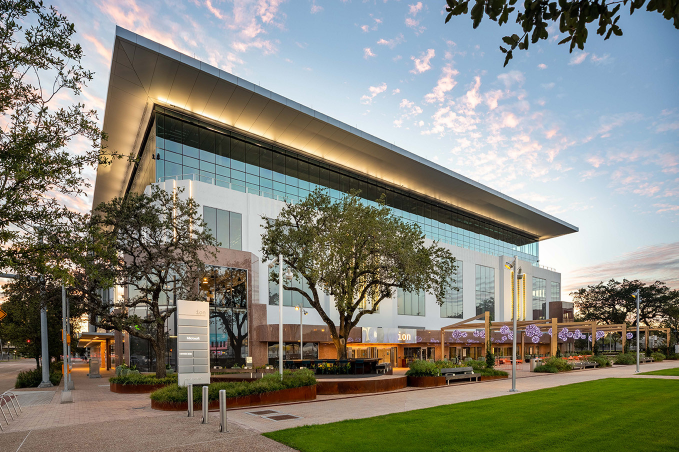
The Arc’s location within the Ion District positions the new facility to extend the district’s success as a hub for innovative ideas and collaboration. The Ion building — now over 90% leased — includes tenants and corporate partners from Chevron, Microsoft, Aramco, Baker Botts, ExxonMobil, Oxy, BP, Shell, United, Transocean and Woodside Energy as well as leading startups and investors such as Persona AI and Liongard. This impressive roster demonstrates the Ion’s strong market demand as a destination for innovation-driven companies. The Arc, which will share a plaza with the Ion, will be purpose-built to accelerate the transition of ideas from the lab to the marketplace and support a broad spectrum of research and enterprise activities.

Rice University: Powering research at The Arc

Rice University will be a lead tenant at The Arc, occupying almost 30,000 square feet of premier office and lab space for its world-class faculty and students. Rice’s presence will offer cross-disciplinary research and idea exchange with a focus on key fields of energy, artificial intelligence, data science, robotics and computational engineering. The Arc will accelerate the translation of discoveries from the laboratory to real-world solutions by connecting Rice’s academic resources and research infrastructure with industry, institutional and entrepreneurial partners.

“The Arc will offer Rice the opportunity to deepen its commitment to fostering world-changing innovation by bringing our leading minds and breakthrough discoveries into direct engagement with Houston’s thriving entrepreneurial ecosystem,” Rice President Reginald DesRoches said. “Working side by side with industry experts and actual end users at the Ion District uniquely positions our faculty and students to form partnerships and collaborations that might not be possible elsewhere. We look forward to building on our legacy of academic excellence to inspire new ventures, advance bold research and deliver solutions that will transform our community and the world around us.”

The Arc
Rendering by Neoscape courtesy of HKS.

A design for the future

Designed with flexibility, The Arc will offer floor plates ranging from 28,000 to 31,000 square feet and generous 15-foot floor-to-floor heights. Infrastructure will be future-proofed to accommodate advanced HVAC, high-capacity electrical and emergency power systems and core lab systems that meet demanding research requirements. The project is targeting LEED Gold certification, integrating smart building automation and energy-saving features to promote sustainability and operational excellence.

Within The Arc, tenants and visitors will benefit from a suite of amenities designed to foster wellness, creativity and community. Highlights include a fully equipped gym, an amenity lounge, conference and meeting spaces and expansive outdoor plazas for events and informal gatherings. Additional conveniences include underground parking, secure bike storage, on-site retail and dining and proximity to the METRORail Red Line — all within one of Houston’s most vibrant and walkable districts. Tenants will also have access to the Ion’s public amenities, including shared conference areas and the forum stairs amphitheater, further supporting opportunities for collaboration and community engagement.

“We are thrilled to collaborate with Rice University and play a role in shaping the next chapter of the Ion District,” said Gabe Lerner, executive vice president of Lincoln Property Co. “The Arc at the Ion District represents a rare opportunity to help add to and grow a nationally significant innovation hub right here in Houston — one that fosters breakthrough ideas, fuels inclusive economic growth and anchors the city’s rise as a global leader in science and technology.”

“The Arc at the Ion District will be more than a building — it will be a catalyst for the partnerships, innovations and discoveries that will define Houston’s future in science and technology,” said Ken Jett, president of Rice Real Estate Co. “By expanding our urban innovation ecosystem, The Arc will attract leading organizations and talent to Houston, further strengthening our city’s position as a hub for scientific and entrepreneurial progress.”

Construction timeline, preleasing

Construction on The Arc is expected to begin in the second quarter of 2026, with completion anticipated in the first quarter of 2028. Preleasing opportunities are now open for organizations ready to join Rice at the heart of Houston’s innovation future. For more information, visit TheArcIonDistrict.com.

New Morning Speaker Series at the Ion Spotlights NASA Space Stories

Innovation doesn’t just happen in labs or boardrooms—it happens when stories are shared, and ideas and imaginations are sparked. That’s why we’re thrilled to announce the launch of a new speaker series: NASA Stories at the Ion.

This morning series will spotlight the human side of space exploration. Each session will feature personal and powerful stories from astronauts and key NASA personnel. From breathtaking missions aboard the ISS to unexpected lessons in leadership and teamwork, this series offers a behind-the-scenes look at spaceflight, told by the people who’ve lived it.

Join us for the inaugural edition of “NASA Stories at the Ion” on Tuesday, July 1 featuring veteran NASA astronaut Dr. Tracy C. Dyson. In this conversation, Dr. Dyson will share stories from her remarkable 373 days in space, her experiences aboard the International Space Station, and the leadership lessons she’s learned while orbiting 250 miles above Earth.

NASA Stories at the Ion builds on the success of NASA Tech Talks, offering a new, more personal perspective to complement the technical insights shared in that ongoing series. Together, these programs offer a more complete picture of the innovation, leadership and resilience behind space exploration.

NASA Stories at the Ion is family-friendly and open to the public. This speaker series is designed to inspire anyone curious about what it takes to push the boundaries of human potential. Complimentary breakfast and networking kicks off each event.

Stay tuned! NASA Stories at the Ion is just getting started. Be sure to check the Ion Events Calendar regularly for upcoming speakers and future sessions in this new series.